Mechanical PLC

Engineered for high-volume beverage manufacturers. Explore our CE-certified, PLC-driven bottling units designed for precision, thermal stability, and maximum uptime.


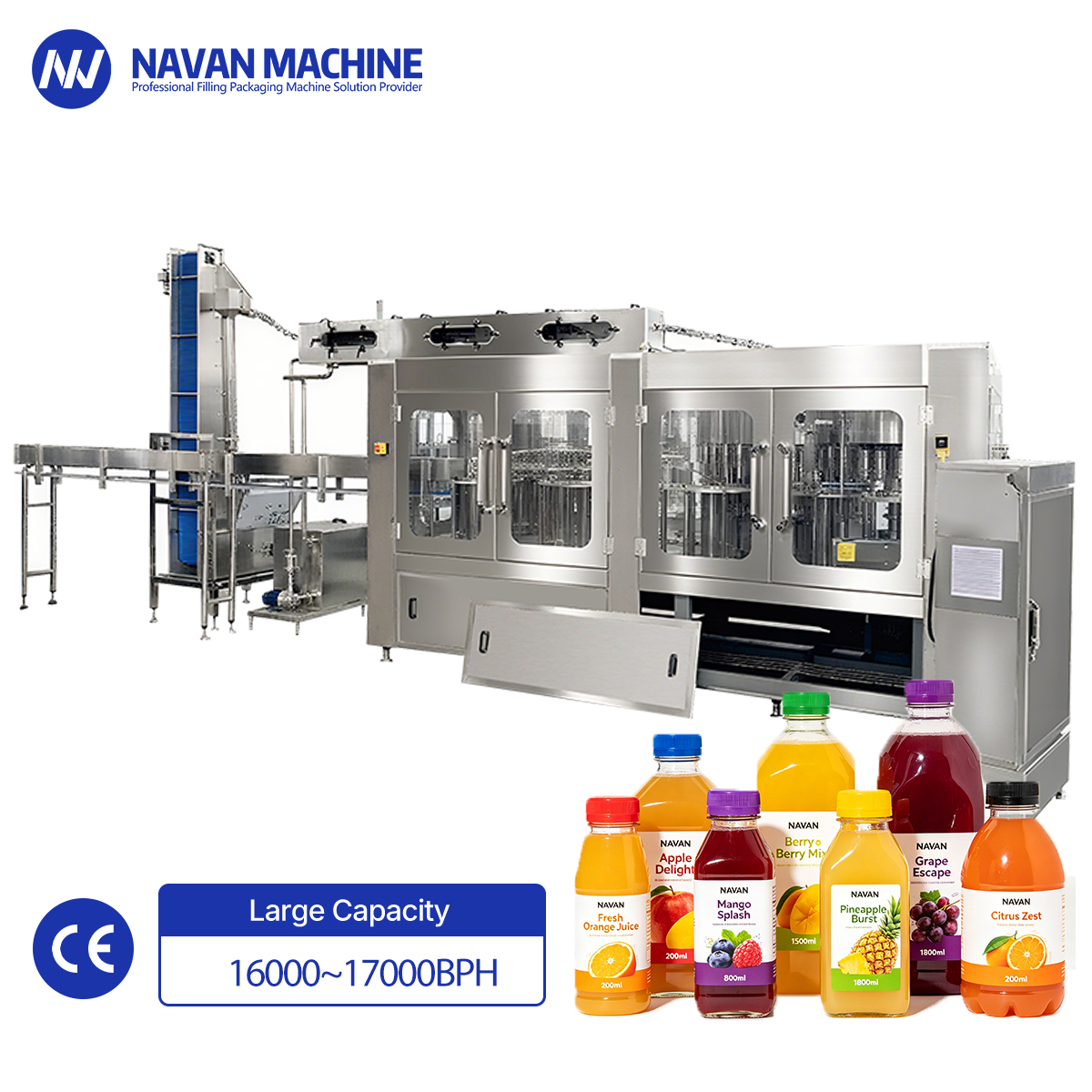


A comprehensive engineering analysis of thermal pasteurization, fluid dynamics, oxygen barrier control, and microbiological safety in automated fruit juice bottling lines.
Modern commercial beverage processing demands stringent microbiological control coupled with thermal optimization to preserve nutritional integrity, organoleptic quality, and shelf life. As a specialized OEM/ODM juice filling machine supplier and wholesaler, Zhangjiagang Osnib Machine Co., Ltd. integrates custom mechanical engineering with intelligent automation to meet the diverse operational parameters of global beverage brands, co-packers, and commercial wholesalers.
Selecting the optimal filling architecture depends heavily on juice chemistry, viscosity, pulp content, and container material. Our OEM/ODM filling solutions support three core technological paradigms:
Maintains product at 85°C–92°C throughout the filling cycle. The liquid itself sterilizes the inner surface of the heat-resistant PET or glass container and the cap closure. Features automated liquid recirculation (reflux) to prevent cooling in nozzle bodies during machine pauses.
Utilizes HEPA Class 100 laminar flow filtration zones combined with peracetic acid (PAA) or sterile water rinsing. Operates at lower temperatures to preserve heat-sensitive vitamins (e.g., Vitamin C in fresh citrus) while extending cold-chain shelf life to 60–90 days.
Achieves complete LOG 5 or LOG 6 reduction through hydrogen peroxide (H2O2) vapor sterilization of preforms or blown bottles. Liquid is pasteurized via UHT (Ultra-High Temperature) and filled at ambient temperatures (20°C–25°C), dramatically reducing PET preform grammage requirements.
The core of any filling monoblock lies in its liquid dosing valve engineering. Osnib Machine offers customized valve configurations tailored to product rheology:
| Filling Principle | Suitable Viscosity Range | Pulp / Particle Handling | Dosing Accuracy | CIP / SIP Compatibility |
|---|---|---|---|---|
| Mechanical Gravity & Vacuum Back-Suction | 1 – 50 cPs (Clear Juices, Isotonic Drinks) | < 0.5 mm micro-pulp | ± 2.0 mm liquid level | Automated CIP Dummy Cups (316L SS) |
| Magnetic Flowmeter (Electromagnetic) | 1 – 500 cPs (Fruit Nectars, Smoothies) | Up to 3.0 mm pulp particles | ± 0.2% volumetric precision | Full Steam-in-Place (SIP) at 121°C |
| Piston / Servo Volumetric Filling | 500 – 10,000 cPs (Fruit Pastes, Jams, Honey) | Large fruit chunks & gel suspension | ± 0.5% weight accuracy | Clean-in-Place with non-return sanitary valves |
| Isobaric Counter-Pressure | 1 – 20 cPs (Sparkling Juices, CSD, Cider) | None (Requires liquid clarity) | ± 1.5 mm liquid level | Multi-stage automatic CIP loop integration |
How global trade dynamics, sustainability mandates, and factory automation are reshaping procurement strategies for juice packaging equipment buyers.
Global environmental regulations are forcing brands to adopt up to 100% recycled PET (rPET) and reduce bottle wall thickness. Modern blow-fill-cap combi-blocks must feature ultra-precise preform heating profiles and neck-handling starwheels to handle lightweight preforms without structural buckling during hot-fill cooling cycles.
Wholesalers and multi-plant enterprise operations are prioritizing machinery equipped with IO-Link sensors, Siemens PLC architectures, and MQTT/OPC-UA protocols. Remote cloud diagnostics allow equipment manufacturers to perform predictive maintenance, audit OEE (Overall Equipment Effectiveness), and resolve logic faults instantly worldwide.
Rather than focusing strictly on upfront capital expenditure (CAPEX), international buyers evaluate energy consumption per thousand bottles, compressed air recovery ratios (e.g., 30% air recycling on PET blowing units), and replacement part standardization to minimize lifetime operational expenditure (OPEX).
The evolutionary trajectory of automated bottling engineering: From mechanical linkage systems to servo-integrated digital filling ecosystems.
All product-contact fluid paths are constructed using certified AISI 316L stainless steel with electro-polished internal surfaces (Ra < 0.4 µm). Eliminate dead spaces, sharp angles, and exposed threads where microbial biofilm build-up could occur during production runs.
To preserve natural color, prevent oxidation of flavor compounds, and retain nutrient potency, modern filling heads incorporate pre-filling N2 gas flushing and post-fill headspace nitrogen dosing prior to immediate capping closure.
OEM/ODM lines feature quick-release starwheels, motor-driven height adjustment, and recipe-stored PLC programs. Facilities can switch from 200ml single-serve PET bottles to 2000ml family containers in under 30 minutes with zero manual re-calibration.
A TÜV Rheinland-verified manufacturer delivering complete turnkey bottling solutions from Zhangjiagang, China to over 40 countries worldwide.
Passed comprehensive onsite operational audits by TÜV Rheinland. All primary filling, PET blowing, labeling, and palletizing machinery carry full CE certification for strict EU and global regulatory compliance.
Beyond our engineering headquarters in Jiangsu, China, we operate established regional service offices in Kigali, Rwanda (Africa Branch) and Goryachy Klyuch, Krasnodar Krai (Russia Office), providing rapid deployment for installation, commissioning, and localized technical service.
We provide full single-source accountability covering water treatment systems (RO/UF), pre-processing mixing tanks, PET blow molding, 3-in-1 rinsing-filling-capping monoblocks, OPP hot-melt or sleeve labeling, PE film shrink wrapping, and automated palletizing systems.
In-depth technical and commercial answers addressing common operational, engineering, and logistics considerations for beverage producers.
Hot filling relies on heating the juice product to between 85°C and 92°C before filling it into specialized heat-resistant PET bottles or glass containers. The liquid heat sterilizes the container interior and cap, eliminating micro-organisms. After filling and capping, the bottle passes through a cooling tunnel to rapidly lower the temperature, preventing heat damage to flavor compounds.
Aseptic cold filling, conversely, pasteurizes the juice using UHT (Ultra-High Temperature) methods for a brief duration, cools it to ambient temperature (20°C), and fills it inside a sterile chamber (Class 100 isolator) into pre-sterilized bottles. While Aseptic filling allows lighter PET bottle weights and better vitamin retention, its initial machinery CAPEX is significantly higher than Hot Fill lines. Osnib Machine offers tailored OEM/ODM configurations for both processes.
Juice oxidation leads to browning, loss of vitamin C, and off-flavors. Our advanced OEM/ODM filling machines incorporate a multi-stage oxidation prevention protocol:
1. Vacuum Deaeration: Pre-processing units strip dissolved oxygen from liquid prior to filling.
2. Inert Gas Purging: High-precision filling nozzles flush the empty bottle with food-grade Nitrogen (N2) before dosing.
3. Headspace Nitrogen Injection: A precise droplet of liquid nitrogen or N2 gas is introduced into the bottle neck space immediately before capping, displacing residual ambient oxygen.
Yes. Handling fruit pulp (such as orange sacs, aloe vera gel, or pineapple pulp) requires specific valve geometry to prevent nozzle clogging and shearing of fruit particles. For juices containing up to 10% pulp or fibers under 3mm, we supply electromagnetic flowmeter or piston-assisted filling valves. For high-pulp products, we engineer a two-stage filling system where pulp is accurately dosed first, followed by clear liquid topping in a monoblock configuration.
Sanitation is paramount in beverage production. All Osnib filling machines feature integrated 316L stainless steel CIP dummy cups that automatically attach to the filling valves via PLC control. The system executes multi-stage cleaning cycles including cold water flush, hot caustic soda (NaOH) wash at 75°C–80°C, acid wash (HNO3) for mineral descaling, and final sterile water rinse. All cycle parameters (temperature, flow rate, chemical concentration, time) are recorded digitally via the PLC touch screen interface.
Our standard automatic PET juice filling monoblocks accommodate container sizes from 200ml up to 2000ml (2.0 Liters). Changing between bottle diameters or height dimensions is facilitated by modular neck-handling starwheels and motorized main-deck height adjusters. Because bottle transportation uses neck-hanging technology, bottles with identical neck finish standards (e.g., 28mm PCO 1810 / 1881 or 38mm Hot-Fill neck) require minimal mechanical changeover time.
Zhangjiagang Osnib Machine Co., Ltd. has undergone comprehensive onsite supplier assessment and verification by TÜV Rheinland. Furthermore, our entire machinery portfolio—including PET blow molding units, liquid fillers, labeling machines, film shrink wrappers, and palletizers—carries full CE certification meeting European safety, electrical, and pressure vessel directives.
We deploy senior field service engineers globally for onsite setup, layout verification, electrical wiring, machine commissioning, and staff operational training. To ensure fast local response times, we maintain permanent branch offices and regional engineering teams in Kigali, Rwanda for African clients and Krasnodar Krai, Russia for CIS clients, supplemented by 7×24 real-time online remote telemetry support.
Standard standalone equipment lead times range from 30 to 45 business days. Complete turnkey lines (comprising water treatment, blowing, filling, labeling, and packing) typically require 60 to 75 days depending on automation complexity. We offer flexible commercial terms including T/T (Telegraphic Transfer) and L/C (Irrevocable Letter of Credit at sight), and accept major currencies including USD, EUR, GBP, and CNY under standard Incoterms (FOB, CIF, CFR, DDP, EXW).
Whether you are establishing a new fruit juice bottling facility or upgrading an existing high-speed packaging line, our engineering team will calculate your line efficiency, utility requirement, and complete workshop layout.
